
Flammability and coexistence
Creators & Contributors

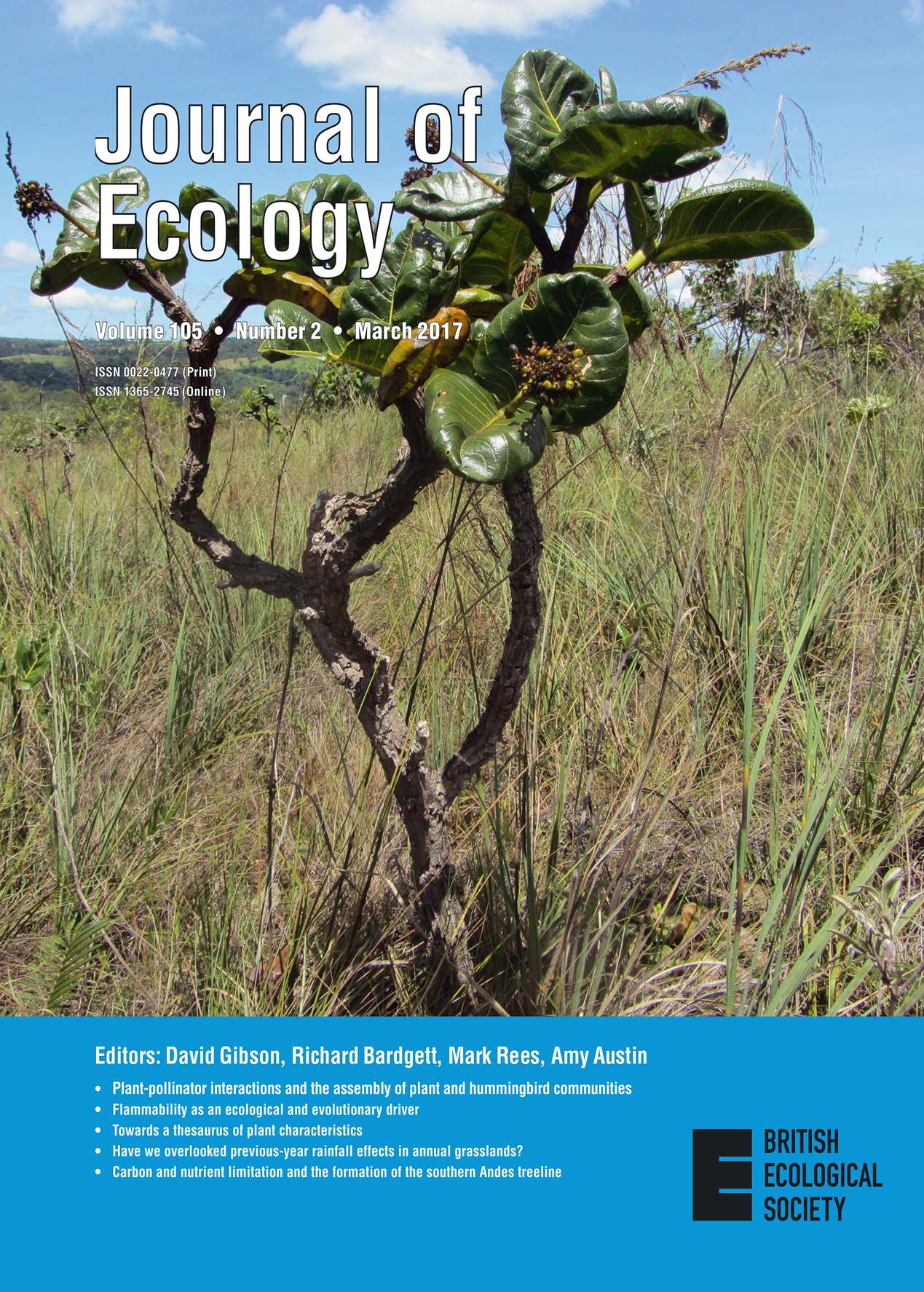
In the cover of the March issue of the Journal of Ecology (105:2) there is a picture of Palicourea rigida (Rubiaceae), a plant growing in the Brazilian savannas (cerrado). It is an example of a plant that survives in a very flammable environment (grassy savanna) thanks to a set of traits conferring very low flammability, including a very low specific leave area and a thick corky bark. Grasses generates fast fires of low intensity (fast-flammable strategy), and in this environment, having low flammability is adaptive as it increases survival (non-flammable strategy). That is, different (contrasted) flammability strategies allows coexistence. For the definition of the different flammability strategies see [1].
(photo by J.G. Pausas)
[1] Pausas J.G., Keeley J.E., Schwilk D.W. 2017. Flammability as an ecological and evolutionary driver. Journal of Ecology 105: 289-297. [doi | wiley | pdf | blog | brief]
Additional details
Description
In the cover of the March issue of the Journal of Ecology (105:2) there is a picture of Palicourea rigida (Rubiaceae), a plant growing in the Brazilian savannas (cerrado). It is an example of a plant that survives in a very flammable environment (grassy savanna) thanks to a set of traits conferring very low flammability, […]
Identifiers
- GUID
- http://jgpausas.blogs.uv.es/?p=3691
- URL
- https://jgpausas.blogs.uv.es/2017/03/03/flammability-and-coexistence/
Dates
- Issued
-
2017-03-03T15:42:05
- Updated
-
2017-03-04T18:06:42