
BSM vs. QSM in Liquid Chromatography: Which Solvent Manager Should You Actually Choose?
Creators & Contributors


Choosing the right solvent manager for a modern liquid chromatography system is one of the most important decisions a laboratory makes. The design of the solvent delivery system directly affects dwell volume, gradient accuracy, re-equilibration time, peak shape, retention time consistency, and overall productivity. In recent years, advances in pump design and mixing technology have reduced the performance gap between high-pressure binary systems and low-pressure quaternary systems, but fundamental trade-offs remain. This guide explains the key differences, provides quantitative performance data, and offers a decision framework based on established chromatography principles.
Core Definitions
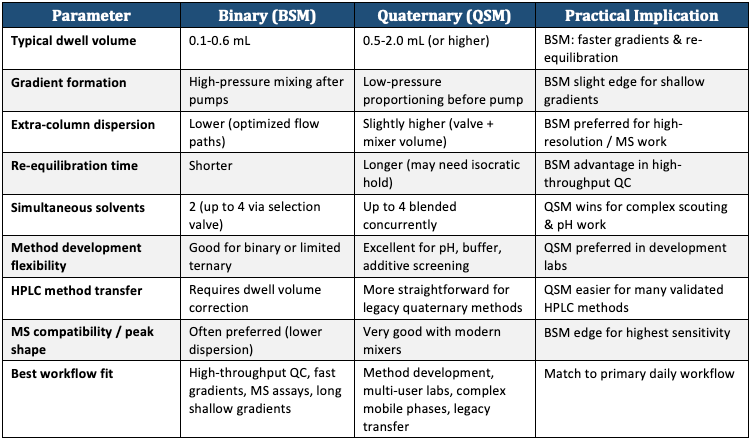
Binary Solvent Manager (BSM): High-pressure mixing architecture features a dedicated pump for each solvent. The streams combine in a mixer located downstream of the pump heads. Since mixing occurs after pressurization, the pump heads and inlet tubing contribute minimally to the gradient delay volume. Typical dwell volumes in modern systems range from 0.1 to 0.6 mL (Snyder et al., 2010; Dolan, 2006). High-pressure mixing pumps provide precise gradients and are ideal for rapid gradients and mass spectrometry workflows.
Quaternary Solvent Manager (QSM): Low-pressure mixing occurs through a proportioning valve located upstream of a single pump head. Up to four solvents can be metered simultaneously before pressurization, enabling true multi-solvent blending without manual valve switching. Dwell volumes are larger, typically ranging from 0.5 to 2.0 mL or more, depending on the configuration and mixer volume (Dolan, 2006). Modern quaternary pumps include efficient mixers and active damping to achieve the same level of precision as binary pumps.
How Binary and Quaternary Systems Mix Solvents
High-pressure mixing (binary) and low-pressure mixing (quaternary) fundamentally differ in where blending takes place. In a binary system, each pump head supplies its designated solvent at the programmed flow rate, and the streams merge just before the column. Because the mixing point is downstream of the pump heads, there is very little internal volume between the solvent blending and the column. This reduces the time needed for changes in mobile-phase composition to reach the stationary phase (Snyder et al., 2010).
A good way to visualize high-pressure mixing is with two separate garden hoses from different taps that join near the sprinkler, rather than back at the house. You control the ratio by adjusting each tap independently. Because the streams combine late in the flow, there is relatively little volume after the mixing point, so changes in composition reach the column more quickly. This helps explain why binary high-pressure mixing systems usually provide lower dwell volume and faster gradient response.
In a quaternary system, a proportioning valve releases small packets of up to four solvents at atmospheric pressure. These packets are mixed and then pulled through a single pump head. The pump and related tubing form part of the mixing volume, so it takes longer for changes in solvent composition to reach the column.
In contrast, low-pressure mixing is like a single long garden hose connected to a smart proportioning valve at the house. The valve quickly switches between up to four different taps to set the desired ratio, and the solvent mixture is created early in the flow before traveling the length of the hose to the sprinkler. This offers great flexibility for blending multiple solvents on the fly, but it also means that a larger downstream volume separates gradient formation from the column, increasing dwell volume and delaying the arrival of the new composition.
The Invisible Factor: Dwell Volume and Its Importance for Gradient Methods
Dwell volume, also known as gradient delay volume, is the internal space from where the solvent mixes to the column inlet. It directly affects how quickly a programmed change in mobile-phase composition reaches the stationary phase (Snyder et al., 2010; Dolan, 2006).
Typical values: BSM systems 0.1-0.6 mL; QSM systems 0.5-2.0 mL or higher, depending on configuration and mixer volume. Longer dwell volumes introduce an initial isocratic phase before the gradient reaches the column. This delay can reduce throughput and shift retention times when methods are transferred between instruments (Bos et al., 2021; Dolan, 2013).
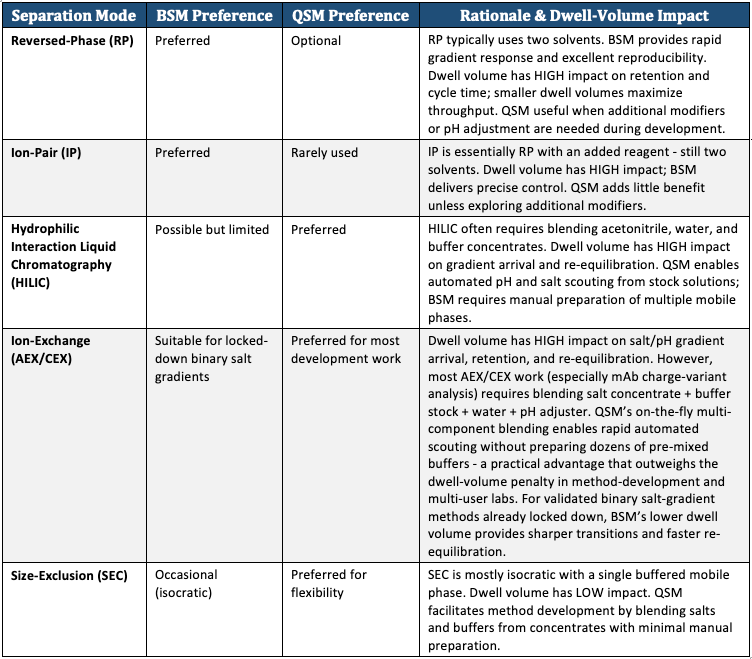
Dwell volume effects are particularly important for any gradient elution method (reversed-phase, HILIC, ion-exchange salt, or pH gradients) because the delay shifts when the changing mobile phase actually reaches the column, impacting retention, selectivity, and re-equilibration time. For purely isocratic methods, such as size-exclusion chromatography, dwell volume has minimal effect.
A helpful way to understand dwell volume is to imagine a garden hose left outside on a hot summer day. The water inside a long hose heats up from the sun. When you turn on the cold tap, the hot water from the hose flows out first for a while before the actual cold water from the tap reaches the sprinkler at the other end. A shorter hose changes this almost immediately. The amount of water trapped in the hose is the dwell volume, which delays the arrival of fresh water at the faucet. The longer the hose (larger dwell volume), the more 'old' hot water must be flushed out before the 'new' cold water arrives.
Another common illustration is the shower in an older house with long pipes versus a modern bathroom with short, direct plumbing. In the old house, you stand shivering while the hot water travels the long distance from the heater; in the modern setup, the temperature changes almost instantly. Both analogies highlight why systems with smaller dwell volumes feel more responsive and why method transfer between different instruments requires careful adjustment of gradient timing or an initial isocratic hold (Dolan, 2013).
Detailed Performance Comparison
The following table summarizes key performance parameters with typical quantitative ranges drawn from the literature.
Suitability by Separation Mode
Dwell volume is crucial in gradient-dependent separations because it delays the arrival of the mobile phase at the column, thereby affecting retention times and re-equilibration. The table below shows the preferred solvent manager for each main mode and explains the reasoning.
When to Choose BSM
Choose a Binary Solvent Manager when your main goal is top chromatographic performance and speed:
High-throughput quality control or screening processes where every second matters
Methods that need long, gentle gradients or very low flow rates
Tasks requiring the best peak resolution and MS sensitivity
Situations where retention time accuracy is essential (e.g., critical quality attributes)
Mainly using two solvents and rarely need multi-solvent scouting
When to Choose QSM
Select a Quaternary Solvent Manager when flexibility is a priority:
Conducting extensive method development with multiple mobile phase combinations or pH testing
Frequently screening buffers, additives, or complex ternary/quaternary gradients
Transferring methods from traditional HPLC systems (many legacy methods are quaternary)
Supporting multi-user environments or instruments handling various projects
Prioritizing cost-effective versatility over the lowest dwell volume
Practical Recommendations
Audit your workflow: Measure the amount of time spent on method development versus routine analysis. Track the number of solvents needed per gradient and how often buffer or pH adjustments are made.
Review detection methods and column sizes: LC-MS workflows and small-volume columns work best with minimal extra-column volume. If you mainly use MS or small ID columns, a high-pressure binary system or a hybrid quaternary pump with low delay volume could be beneficial.
Think about future growth: Instruments with adjustable gradient-delay volumes and modular mixing components can accommodate changing analytical needs.
Use built-in safety features: Options such as controlled start-up, energy-saving standby modes, and solvent-level alarms help reduce column wear and cut operating costs.
Conduct practical tests: When unsure, run representative methods on both pump types. Check how dwell volume affects results, gradient accuracy, and peak shape under your usual conditions. Often, real data differences are smaller than what the specification sheet indicates, especially on modern systems (Seidl C, et al., 2019).
Bottom Line
There is no universally superior solvent manager. The best choice depends on how you spend most of your time in the lab. Assess your main workflows, such as method development volume, required gradient complexity, throughput goals, and detection needs, before making a decision. Modern systems from all major manufacturers have narrowed the performance gap; many labs have both configurations or use software tools to account for differences in dwell volume during method transfer. The binary system offers precision and speed. The quaternary system provides flexibility and versatility. Choose based on how you actually work in the lab, not on which one has the cooler acronym.
References
Snyder LR, Kirkland JJ, Dolan JW. Introduction to Modern Liquid Chromatography. 3rd ed. Wiley; 2010.
Dolan JW. Dwell volume revisited. LCGC North America. 2006;24(5):458-466.
Dolan JW. Gradient elution, Part IV: Dwell-volume problems. LCGC North America. 2013;31(6):456-463.
Bos TS, et al. Reducing the influence of geometry-induced gradient deformation in liquid chromatographic retention modelling. J Chromatogr A. 2021;1635:461714.
Seidl C, et al. A study of the re-equilibration of hydrophilic interaction chromatography columns with a focus on viability for use in two-dimensional liquid chromatography. J Chromatogr A. 2019;1603:58-66.
Additional details
Description
A practical, research-backed guide to binary and quaternary pumps in liquid chromatography, covering dwell volume, gradient performance, method development flexibility, and real-world decision-making
Identifiers
- GUID
- 195304821
- URL
- https://abrahamfinny.substack.com/p/bsm-vs-qsm-in-liquid-chromatography
Dates
- Issued
-
2026-04-24T12:43:50
- Updated
-
2026-04-24T12:43:50
References
- Snyder LR, Kirkland JJ, Dolan JW. Introduction to Modern Liquid Chromatography. 3rd ed. Wiley; 2010.
- Dolan JW. Dwell volume revisited. LCGC North America. 2006;24(5):458-466.
- Dolan JW. Gradient elution, Part IV: Dwell-volume problems. LCGC North America. 2013;31(6):456-463.
- Bos TS, et al. Reducing the influence of geometry-induced gradient deformation in liquid chromatographic retention modelling. J Chromatogr A. 2021;1635:461714.
- Seidl C, et al. A study of the re-equilibration of hydrophilic interaction chromatography columns with a focus on viability for use in two-dimensional liquid chromatography. J Chromatogr A. 2019;1603:58-66.