Critical Metascience Roundup
Creators & Contributors

Summary
20:20 hindsight on scientific progress
Open research in the humanities
The role of scientific sleuths
Individual bias and collective criticism
20:20 Hindsight on Scientific Progress
Whitney Barlow Robles looks back over the history of scientific progress and notes that a lot of it would look "unscientific" by today's standards . . . which will look "unscientific" in the future!
People sometimes look back at past scientists and ask:
"Could they really have been this dumb? Thank goodness we know better."
In response, Robles argues that science sometimes "progresses" in terrible ways, and that:
Brushing off these practices as unscientific implies that "true" science is, and always has been, unimpeachable. It denies us a chance to examine what flaws may fuel our own ways of thinking. And it absolves us from reckoning with the wreckage of the scientific past.
Robles, W. B. (2026, April 16). They thought what? Contingent Magazine. https://contingentmagazine.org/2026/04/16/they-thought-what/
Open Research in the Humanities
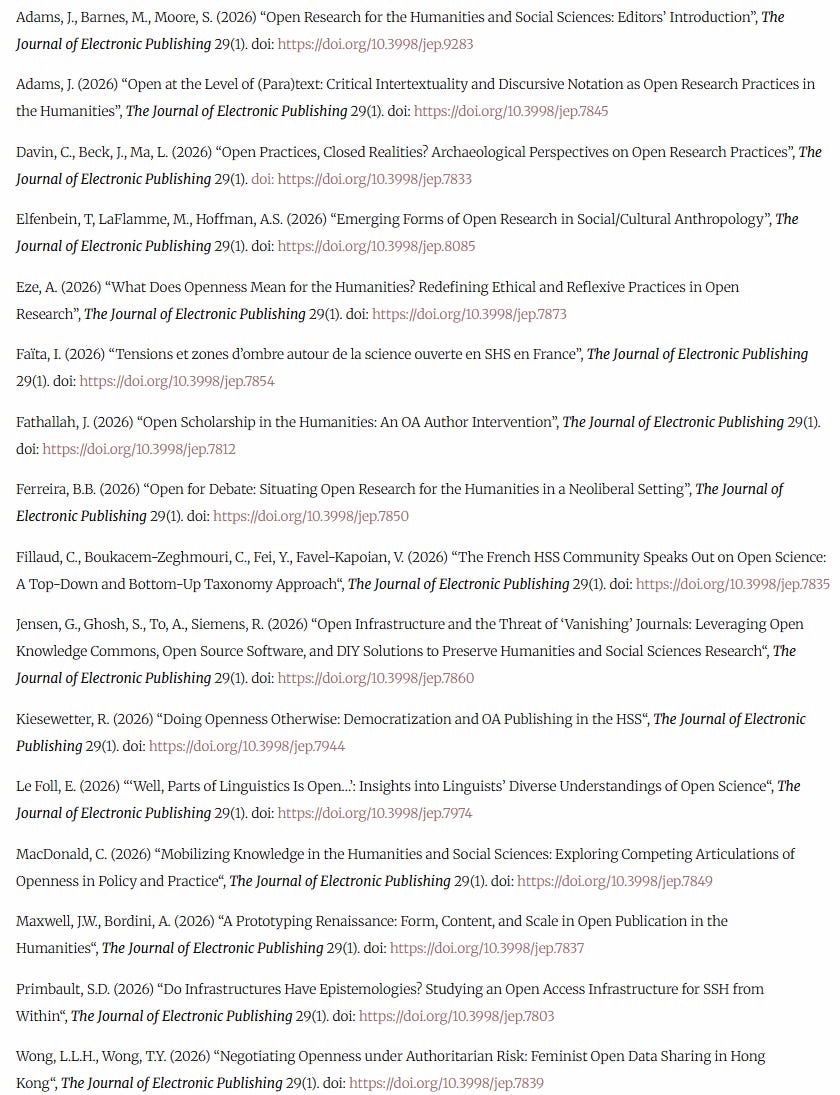
Beatriz Ferreira's recent article considers open research in the humanities:
[It] contributes to the broader discussion on the need to reframe openness not as a set of procedural norms or policy mandates, but as a relational and epistemically situated practice.
Ferreira, B. B. (2026). Open for debate: Situating open research for the humanities in a neoliberal setting. The Journal of Electronic Publishing 29(1). https://doi.org/10.3998/jep.7850
This article is part of a special issue on "Open Research for the Humanities and Social Sciences," edited by Jenni Adams, , and Samuel Moore: https://journals.publishing.umich.edu/jep/issue/456/info/
The Role of Scientific Sleuths
Serge Horbach and Auste Valinciute interrogate the emerging and contested role of the "scientific sleuth" in forensic metascience.
[Sleuths] form a distinct class of actors, most importantly because of the absence of formal accountability structures. This has triggered comparisons of scientific sleuthing to vigilantism.
Serge, P. M. J., & Horbach, A. V. (2026). Contextualizing the emerging and contested role of sleuths in the science monitoring system. Science and Public Policy, scag044, https://doi.org/10.1093/scipol/scag044
Individual Bias and Collective Criticism
Commenting on a recent paper by Shiffrin et al. (2026), Steven Sloman and Almos Molnar argue that:
The target article provides an abundant collection of biases that influence scientists .... But all of this depends on viewing scientific activity according to what Chater and Loewenstein (2023) refer to as an 'i-frame,' that is, a focus on the behavior of individuals.
In contrast, they consider the collective adversarial dynamics of the scientific community and conclude that:
In this collective dynamic, there is even a 'methodological justification for individual scientists to be biased', because only when ideas are tenaciously defended by some and tenaciously criticized by others, can we discern their true merit (Popper, 1994: 93).
Sloman, S. A., & Molnar, A. C. (2026). Are scientists naïve humans? Computational Brain and Behavior. https://doi.org/10.1007/s42113-026-00296-6
Additional details
Description
Update #4 - 20:20 hindsight on scientific progress - Open research in the humanities - The role of scientific sleuths - Individual bias and collective criticism
Identifiers
- UUID
- ac146318-5ef2-4f3a-97f6-17134829878b
- GUID
- 195555592
- URL
- https://markrubin.substack.com/p/critical-metascience-roundup-a8d
Dates
- Issued
-
2026-04-26T20:35:14
- Updated
-
2026-04-26T20:35:14