OJS 3.6: Bringing Manuscript Editing and Production under one Roof
Creators & Contributors
Upload, edit, publish, all in one place. OJS, OMP, and OPS 3.6 cover the journey from manuscript to on the fly HTML, PDF, and JATS XML production.
Thanks to extensive community input gathered through the PKP Forum, webinars, and working groups — and to funding from the Open Research Europe project — the upcoming 3.6 release will include an integrated HTML editing tool and the ability to generate HTML, PDF, and JATS XML files using HTML as the canonical source.
The direction was validated at the 2024 PKP Turin Sprint where attendees explored these capabilities in a dedicated typesetting working group, refining key design and implementation assumptions.
Removing Offline Dependencies with the Integrated Text Editor
The integrated text editor uses SciFlow, a tool that generates clean, stripped-down markup with only the essential structural and semantic elements needed for rendering.

Note that the text editor is an option for Editors who prefer to work inside of the software but the legacy workflow involving desktop tools and third-party services remains available.
Integrated Text Editor Features
The editor's interface will be familiar to users of text editors such as Word or Google Docs. The standard structural tools available include fonts, basic tables, headers, etc. Keyboard notations can be used for structures such as headers, ordered and unordered lists, fonts, and more.
Mathematical formulas are handled via MathJax integration and editors have the option to directly author and edit LaTeX via the sidebar.
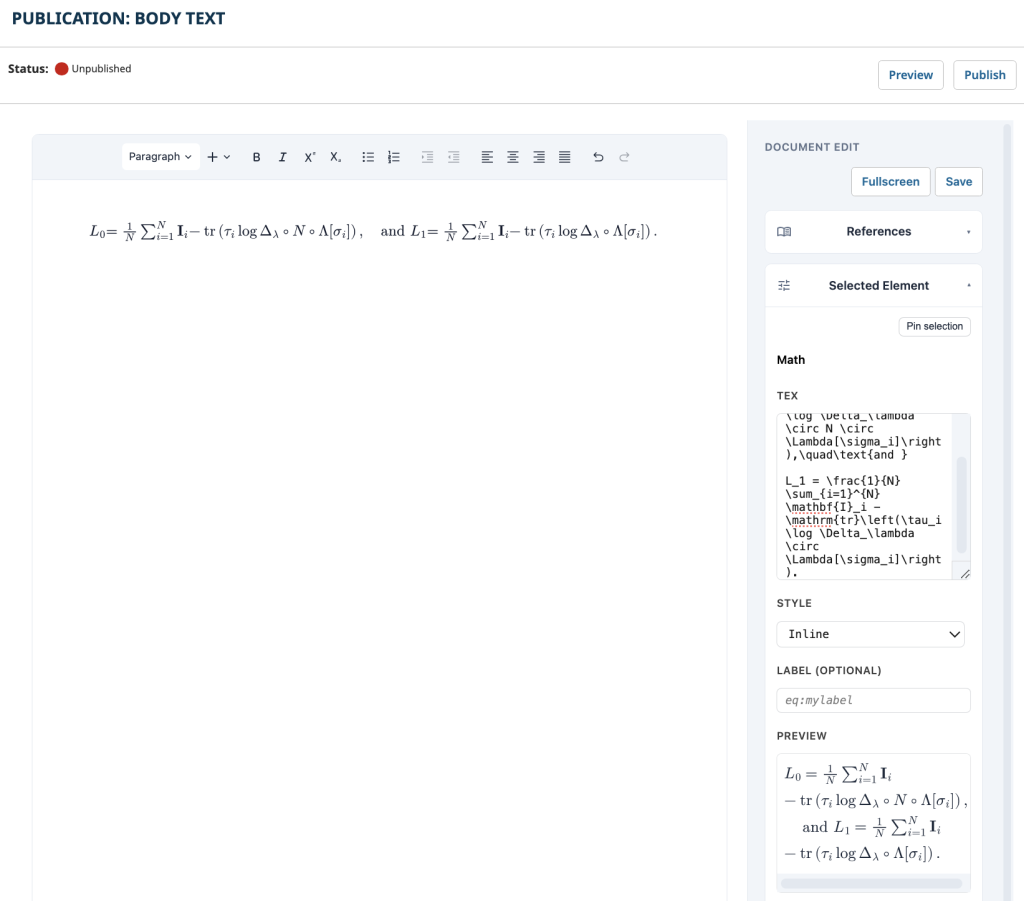
Although only body text is shared to the integrated text editor, metadata such as references are listed in the sidebar and can be dragged onto text for quick linking.
Citations can be edited or added on the fly by selecting the desired text and interacting with the sidebar tools.
Upload, Edit, Save
The new text editor is available as an in-software alternative that does not disrupt existing workflows.
1. Submission Upload
 The Author uploads their manuscript e.g., Word document
If the Grobid plugin is enabled, manuscript metadata such as titles and abstracts can be auto-extracted into the submission form
2. Review
Integrated text editor walkthrough by Jarda Kotěšovec, Front-end Software Lead at PKP
The uploaded manuscript file can be shared with the text editor at any stage (submission, review, copyediting, production) in the workflow using the "send to text editor" option.
Only the main content of the article is shared with the text editor. i.e., the content on the title page is not editable using this method.
3. Edit
Edit the article content
Save your changes. This saves the body text HTML as the canonical source within the software.
On the Fly File Production and Export
In previous releases, files such as HTML, PDF, and JATS XML were created offline and uploaded to the galley. For an HTML version of the article to be displayed in the public-facing website required the existence of an HTML file in the gallery. Similarly, PDF and other downloadable files from the public website required these files to be manually kept up to date in the galley. This created a labour-intensive and potentially costly workflow where every update required external services to regenerate and re-upload files.
With the 3.6 release, file creation functionality takes the body text HTML created by the integrated editor and, when triggered by the Editor, the system produces HTML, PDF, and JATS XML files for display and download. This will reduce an Editor's manual workload, satisfy PubMed's JATS XML export requirement, and allow journal-specific templates and styles to be applied for a consistent look and feel.
The following file production paths can be triggered by the Editor after moving submissions to the production stage.
Body text HTML Conversion to HTML, PDF, and JATS XML
Body text HTML to HTML Galley
Using a template, the journal's stylesheet is applied to the body text HTML. The resulting file can appear inline or as a standalone HTML page on the journal's public-facing website.
Body text HTML to HTML to PDF Galley
Similarly, a template and stylesheet is applied to the body text HTML to produce a downloadable PDF from HTML, consistent with the journal's look and feel. Body text HTML to JATS XML Galley
The structured content is exported to JATS XML for indexing and archiving with services such as PubMed.
Check out the May 25th Development Update News webinar where PKP developers talk about file production, high-resolution file handling, and more upcoming features coming in the 3.6 release.
References
- Full-text editor GitHub #10419
- Investigating PDF generation GitHub #10437
- Article Production: Directions and Plans (June 2025)
- PKP Turin 2024 Typesetting (Nov 2024)
- Working group discussion recap from the PKP Turin Sprint 2024
The post OJS 3.6: Bringing Manuscript Editing and Production under one Roof appeared first on Public Knowledge Project.
Additional details
Description
Upload, edit, publish, all in one place.
Identifiers
- UUID
- eb5b8270-1bae-4ddb-96ce-f7f73a25f30b
- GUID
- https://pkp.sfu.ca/?p=19092
- URL
- https://pkp.sfu.ca/2026/05/26/ojs-3-6-bringing-manuscript-editing-and-production-under-one-roof/
Dates
- Issued
-
2026-05-26T16:50:10
- Updated
-
2026-05-26T16:50:10
References
- Full-text editor GitHub #10419
- Investigating PDF generation GitHub #10437
- Article Production: Directions and Plans (June 2025)
- PKP Turin 2024 Typesetting (Nov 2024)
- Working group discussion recap from the PKP Turin Sprint 2024