Advancing Research Sharing Through DataCite's Global Access Fund: The Arab Council for Social Sciences, Lebanon
Creators & Contributors

Since 2018, and as part of the global movement towards open science and knowledge as a public good, the Arab Council for the Social Sciences (ACSS) has been working to promote norms and practices of social science research data management (RDM) and sharing among social scientists, information specialists, and research institutions in the Arab region. More specifically, the ACSS work on RDM aims to (1) build capacity in managing research data in the Arab region, and (2) preserve* and facilitate access to social science research data on/in the Arab region by providing data management and sharing infrastructure through ACSS Dataverse.
The ACSS is a regional, independent, non-profit organization based in Beirut that is dedicated to strengthening social science research and knowledge production in the Arab region. Among its objectives are (1) the provision of forums for exchange and communication among social scientists in the Arab region; (2) supporting effective networks among research, academics, practitioners, and other communities; and (3) supporting the dissemination of high-quality social science research in the Arab region.
Through the DataCite Global Access Fund (GAF) in 2024 and in alignment with its regional initiatives, DataCite has strengthened its commitment to building a global research ecosystem by providing open infrastructure and persistent identifier (PID) services that connect research and advance knowledge. As part of this effort, the Arab Council for the Social Sciences (ACSS) worked to raise awareness of research data management (RDM) and PIDs in open research infrastructure, aiming to improve research access, visibility, and collaboration for more impactful outcomes. To support this initiative, DataCite facilitated three in-person training workshops on social science RDM and three virtual demonstrations on PIDs and open infrastructure, equipping researchers and institutions with essential knowledge and tools. These efforts reflect DataCite's ongoing dedication to empowering institutions and research communities worldwide, reinforcing its role in strengthening Open Science and advancing global research practices.
Capacity Building in Egypt and Morocco
The global adoption of persistent identifiers (PIDs) services faces several challenges, including a lack of awareness across stakeholders, technical expertise, and institutional policies that support their implementation, particularly in regions with emerging research infrastructure. Capacity-building initiatives are essential in addressing these barriers by promoting awareness of PID services, open metadata, open research practices, and open infrastructure, enabling institutions to integrate these components into their research workflows. In the Arab region, gaps in PID adoption stem from limited training opportunities, a lack of localized resources, and varying institutional commitment to open research, which hinder the seamless connection and discoverability of research outputs. To bridge these gaps, capacity-building efforts must take multiple forms, including targeted training workshops, multilingual resources, collaborative webinars, and regional partnerships that equip institutions with the knowledge and tools to implement PIDs effectively. Strengthening these efforts will not only accelerate PID adoption across the region but also contribute to a more interconnected and visible research ecosystem, aligning with global Open Science initiatives and ensuring equitable access to research infrastructure.
As part of the ACSS series of training workshops on social science RDM, three such workshops were organized in 2024 in partnership with DataCite, as well as universities and research centers in the Arab region. Through a combination of teaching and practical exercises, the three training workshops introduced participants to the RDM and data sharing principles, best practices, and tools, highlighting the importance of PIDs for an open research infrastructure. The training materials used in the workshops are bilingual (Arabic and English).
In total, the three training workshops included 56 researchers and information specialists from 16 universities and research centers. The first was held on 3 October 2024 in Ifrane, Morocco, organized with the School of Humanities and Social Sciences and Mohammed VI Library at Al Akhawayn University in Ifrane (AUI). It was attended by 19 participants from 4 universities in the Atlas region in Morocco:
- Moulay Ismail University – Meknes: 7 participants
- AUI-Mohammed VI Library: 4
- Université Sidi Mohamed Ben Abdellah Sais – Fes: 4
- Université Sidi Mohamed Ben Abdellah-FLDM Dhar Elmehraz – Fes: 4
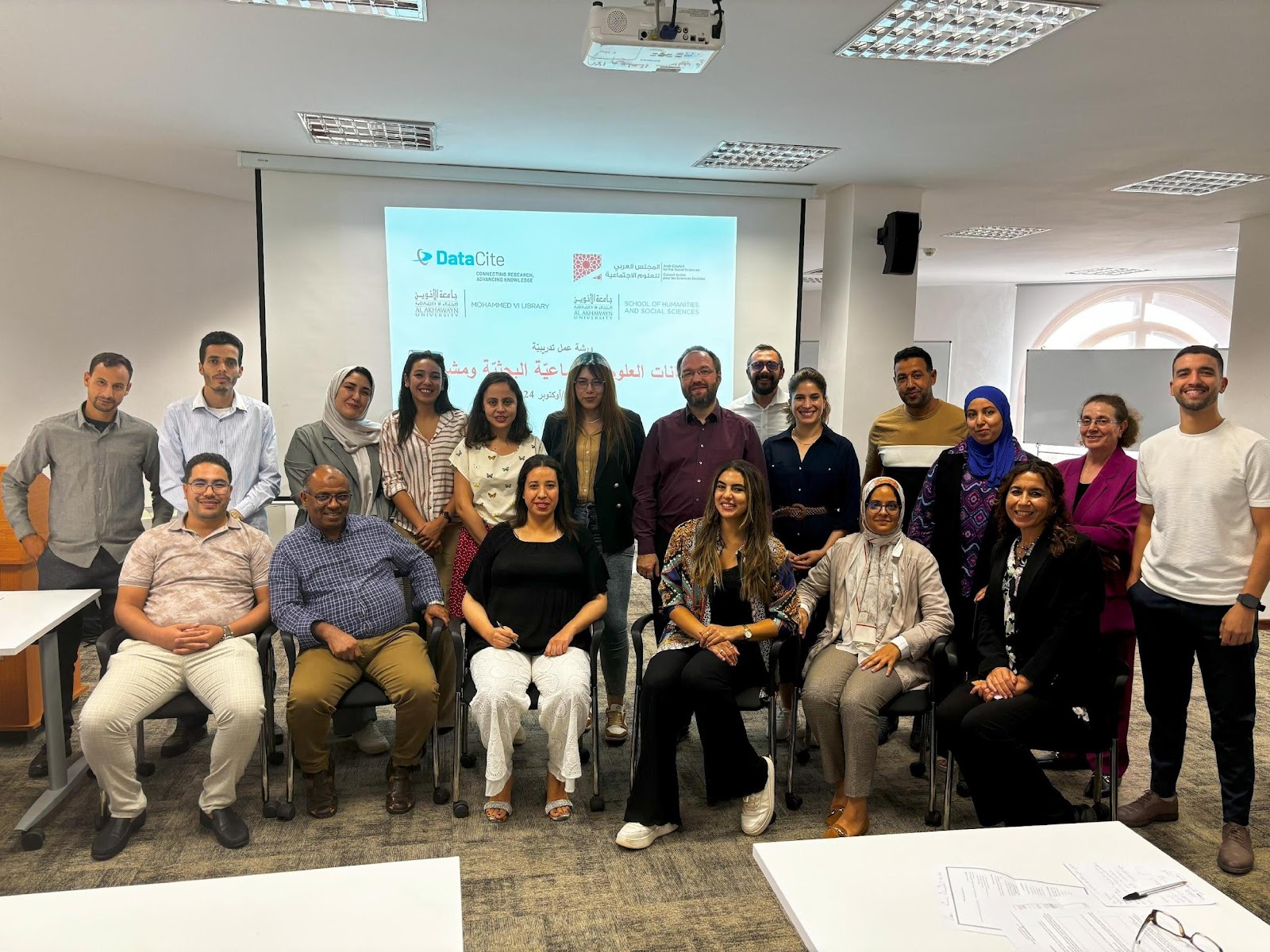

The second workshop took place on 5 October 2024 in Rabat, Morocco, organized with the Rabat Social Studies Institute (RSSI) in Morocco. It was attended by 16 participants from 5 universities and research centers in the Rabat region:
- Université Hassan II de Casablanca: 4 participants
- Université Mohammed V – Souissi: 4
- RSSI: 2
- Archives du Maroc: 2
- Parliament: 4


The third and final workshop on 2 December 2024 in Cairo, Egypt was organized with the School of Humanities and Social Sciences (HUSS) at the American University in Cairo (AUC). It was attended by 21 participants from 7 universities and research centers in the Cairo region. (A presentation by the authors given during the workshop is here).
- AUC: 11 participants
- Cairo University: 4
- Port Said University: 2
- National Museum of Egyptian Civilization: 1
- The Egyptian National Library & Archives: 1
- Information and Decision Support Center: 1
- Speak up Egypt: 1


Practical Demonstrations on PIDs Supported by the DataCite Team
In addition to the workshops, three virtual demonstration sessions were organized with DataCite for the ACSS community that highlighted the importance of open research infrastructure and the value of adopting various PIDs in research workflows to enable the sharing of research outputs with the broader research community, and enhance their discoverability and reusability. The demonstrations showcased examples of integrating ORCID iDs and DOIs for all research outputs—including theses, dissertations, and datasets—and discussed the added value of the Research Organization Registry for institutions.
The first demonstration was held on 29 May as part of a mandatory RDM training for cohort 4 of ACSS NewGen fellows. The NewGen program, in collaboration with a number of public and private Arab universities, seeks to establish a pipeline for a new generation of committed and well-trained social scientists in the Arab region. It provides distinguished students at the undergraduate and graduate levels with the opportunity to join a two-year multi-component journey including methodological and thematic workshops and courses, as well as research, publishing, and networking activities.
The second demonstration was held on 10 July and was part of the ACSS webinar series that aims to reach a wide audience of social scientists and humanists, as well as activists, practitioners, and professionals in different countries of the region. These webinars help enhance interactions between the ACSS and researchers, and foster/consolidate opportunities for networking with regional and international organizations to enhance knowledge production in the social sciences. The webinar was attended by about 60 people and included a lively Q&A session (a recording of the webinar is here).


The third demonstration was held on 24 September and was part of the second ACSS Academy that provides an opportunity for selected junior social science researchers in the Arab region to engage with critical theory and analysis, advanced writing and professionalization skills, and networking.
The three demonstrations were attended by around 150 individuals: 100 participants from the ACSS community during the 10 July webinar, 20 ACSS NewGen fellows, and 28 junior social science researchers who attended the ACSS Academy.
Conclusion and Going Forward
The activities undertaken through the DataCite Global Access Fund (GAF) award advanced capacity building, with DataCite supporting three in-person training workshops across Egypt and Morocco, alongside three virtual sessions focused on research data management (RDM), persistent identifiers (PIDs), and open metadata. These efforts provided trainees with the knowledge and tools needed to strengthen open research practices and enhance the adoption of PIDs in the region. The capacity-building workshops helped create and support communities of researchers and practitioners to work on RDM within their institutions and professional communities. Indeed, some of the trainees plan to present the materials to their colleagues and students. Additionally, some trainees who have been working in Open Science and RDM, expressed interest in becoming trainers themselves. This project has provided the opportunity for future collaboration with the network of organizations and individuals in the Arab region working on RDM, PIDs, and Open Science; collaborations that could create synergies in these areas.
Going forward, ACSS will continue its collaboration with DataCite to advance capacity building, advocate for open infrastructure, and establish a sustainable path for the ACSS Dataverse. As part of these efforts, DataCite will present on advancing knowledge through PIDs and metadata in the region at the 7th Conference of the Arab Council for the Social Sciences in May 2025 in Beirut, Lebanon.
* Those interested in preserving their social science datasets in the ACSS Dataverse, please contact datatverse@theacss.org
Additional details
Description
Since 2018, and as part of the global movement towards open science and knowledge as a public good, the Arab Council for the Social Sciences (ACSS) has been working to promote norms and practices of social science research data management (RDM) and sharing among social scientists, information specialists, and research institutions in the Arab region.
Identifiers
- UUID
- bd198e4a-eddf-4c23-b3fb-44178401a125
- GUID
- https://datacite.org/?p=12178
- URL
- https://datacite.org/blog/advancing-research-sharing-through-datacites-global-access-fund-the-arab-council-for-social-sciences-lebanon/
Dates
- Issued
-
2025-02-11T13:23:12
- Updated
-
2025-02-11T18:23:08