
A fistful of dollars: why corporate publishers have no place in scholarly communication


*During my flyfishing
vacation last year, pretty much nothing was happening on this blog.
Now that I've migrated the blog to WordPress, I can actually schedule
posts to appear when in fact I'm not even at the computer. I'm using
this functionality to re-blog a few posts from the archives during the month of
august while I'm away. This post is from January 10, 2012:
*
With roughly four billion US$ in profit every year, the corporate scholarly publishing industry is a lucrative business. One of the largest of these publishers is Anglo-Dutch Elsevier, part of Reed Elsevier. According to their website, their mission is to
publish trusted, leading-edge Scientific, Technical and Medical (STM) information – pushing the frontiers and fueling a continuous cycle of exploration, discovery and application.
However, Elsevier recently admitted to publishing a set of six fake journals,
aimed to promote medical products and drugs by the company Merck, but
with the appearance of peer-reviewed, scholarly literature. Clearly,
trust is not Elsevier's top priority.
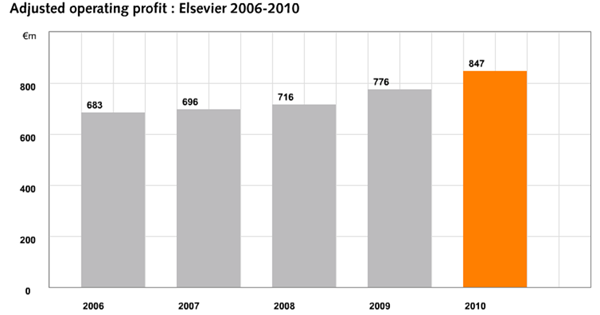
What is Elsevier's top priority, though, is making money. Like all
scholarly publishers, Elsevier is thriving, despite global financial and
economic crises in recent years:
How can a private company be so isolated from the general economy? The
reason is that they're largely funded by the tax payer and so far
education and R&D budgets have been relatively spared. How do
commercial publishers do their job? Here is a brief sketch of how a
scholarly paper comes about:
- Researchers generate data
- Researchers write manuscript
- Publisher's editor sends manuscript to other researchers who peer-review the manuscript at no cost to the publisher
- Researchers modify the manuscript
- Researchers pay page charges
- Publisher copy-edits manuscript and puts it online.
- Library or researcher pays subscription fees to access article
Thus, according to their website, 7,000 paid journal editors are working for the approx. 2,000 journals of Elsevier, while 970,000 unpaid board members, reviewers and authors, largely funded by the tax payer, are donating their time, brains and other valuable resources to the corporation. With hardly any labor costs to speak of and great value provided from outside for free by tax-funded researchers, it is not surprising hat corporate publishers sport great profit margins:
| Publisher | Revenue | Profit | Margin |
| Elsevier | £2b | £724m | 36% |
| Springer's Science + Business Media | €866m | €294m | 33.9% |
| John Wiley & Sons | $253 | $106 | 42% |
| Informa.plc | £145 | £47 | 32.4% |
On top of very small up front costs publishers increase subscription
prices manifold beyond inflation: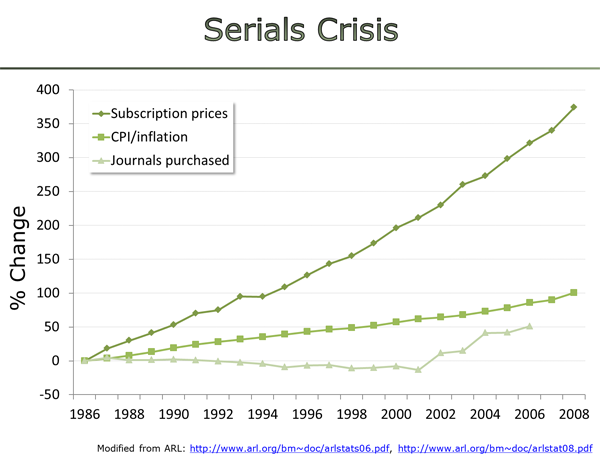
Quite obviously, with low costs and an ever increasing stream of tax
funds burning holes in your pocket, you wonder how all the money could
be invested to protect your shareholder value for the future. Therefore,
commercial publishers:
- Buy access to elected representatives
- Use this access to lobby for protective legislation
- Pay full-time employees for government lobbying
- Support SOPA
- Discredit Open Access by hiring professional 'pit-bull' campaigners
- Lobby against Open Access at the US White House
Comparing commercial with non-profit publishers shows how competition
doesn't bring the price down in scholarly communication: non-profit
publishers are providing a publishing service that is consistently half or less of what commercial publishers
provide (see also here). Therefore, I am very skeptical of suggestions
to transform the scholarly communication ecosystem into a
service business. Given that commercial publishers have a proven
track record of untrustworthiness, price-gouging and political
interference, what would keep them from increasing their prices for the
services they provide, just as they have increased subscription
prices?
No, the evidence is very clear, we need to rid the scholarly
communication system from commercial publishers if we want to reduce or
at least limit the burden on tax-payers:
- Just eliminating profits will cut publishing costs by approx. US$4b annually
- 1.5 million papers will have to be published anyway, so no jobs will be lost, just transferred
- per-publication costs will come down further as scholarly communication becomes completely online.
Any proponent of for-profit scholarly publishing first needs to explain why future commercial publishers' behavior should dramatically change from current and past behavior, before any other arguments will even be considered.
Files
10.59350_cer42-psn51.pdf
Files
(222.5 kB)
| Name | Size | Download all |
|---|---|---|
|
md5:c9554020dad1162465be79d5aee99dc3
|
222.5 kB | Preview Download |
Additional details
Description
*During my flyfishing vacation last year, pretty much nothing was happening on this blog. Now that I've migrated the blog to WordPress, I can actually schedule posts to appear when in fact I'm not even at the computer. I'm using this functionality to re-blog a few posts from the archives during the month of august while I'm away.
Identifiers
- GUID
- http://bjoern.brembs.net/?p=336
- URL
- https://bjoern.brembs.net/2013/08/a-fistful-of-dollars-why-corporate-publishers-have-no-place-in-scholarly-communication
Dates
- Issued
-
2013-08-26T00:00:00Z
- Updated
-
2013-08-26T14:30:57Z