
EMILY ADLAM
SAVING SCIENCE FROM QUANTUM MECHANICS
REVIEWED BY
Steven French
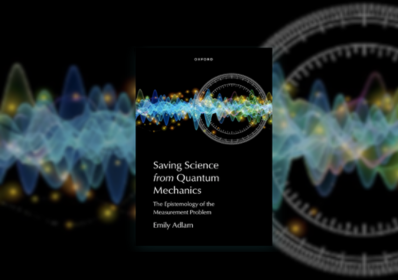
Saving Science from Quantum Mechanics: The Epistemology of the Measurement Problem ◳
Emily Adlam
Oxford University Press, 2025, £59.00
ISBN 9780197808856 / 9780197808887
Cite as:
French, S. (2026). 'Emily Adlam’s Saving Science from Quantum Mechanics', BJPS Review of Books, 2026,
doi.org/10.59350/wcr1m-yhh26

The 'measurement problem' has been described as the bad smell that lingers at the foundations of quantum mechanics. Bluntly put, the issue is this: the theory describes the state of a system as a superposition of possible states, but when a measurement is performed, the outcome is always a definite state. Given that it is such measurements that underpin the impressive empirical success of the theory, it is of fundamental importance that an answer be given to the question: how is this definite state obtained from the superposition?
There is now a much-thumbed menu of responses but Adlam's provocative and robustly defended thesis is that they all 'come at the cost of making scientific knowledge more fragile than we would ideally like it to be' (p. 20). After a short prologue, and having presented some of the formalism of quantum mechanics, she makes it clear that her concern is with empirical scientific knowledge, in the sense of knowledge about observable regularities (p. 17). It is this, she goes on to argue, that is under threat.
Chapter 3 sets out a selection of well-known solutions to the problem, including Everettian 'many worlds' approaches as well as 'observer-relative' interpretations, and Adlam indicates why each raises concerns for scientific epistemology. Before she considers possible responses to these issues in detail, however, she discusses the epistemology of measurement in chapter 4. Here she draws, in particular, on the work of Tal (2013) and others who maintain that, as she puts it: 'Measurement results […] become meaningful and useful for empirical confirmation only in the context of […] a "model" of the measurement process' (p. 45).
Of course, this raises the further question: where does such a model come from in the first place? Following Chang (2007), Adlam adopts a form of 'progressive coherentism', according to which we begin with some rough ideas of the nature of physical reality, which allow us to empirically confirm our hypotheses. These hypotheses, in turn, can then be used to refine and correct those initial assumptions (p. 51). Applied to measurement, this results in a kind of bootstrapping, 'where our assumptions about the reliability of measurement are to be retrospectively refined and justified by our success in arriving at a coherent set of beliefs based on the results of our empirical enquiries' (p. 52). And so, she suggests, one way to understand the significance of the measurement problem is that it indicates a breakdown of this 'progressive bootstrapping procedure' (p. 52).
The overall strategy for identifying the particular causes of this breakdown is laid down in chapter 5. This begins with an important distinction between, on the one hand, 'benign weirdness', in the sense of a clash with our (mostly) classical intuitions, and, on the other, 'epistemic weirdness', meaning that if reality had the features attributed to it by the afore-mentioned responses, then 'standard scientific methods would cease to be a reliable way of learning about reality, and the very possibility of scientific enquiry would be endangered' (p. 58). Acceptance of any solution to the measurement problem involving epistemic weirdness would thus not be epistemically rational, although, as Adlam acknowledges, where to draw the line between these two forms of 'weirdness' may depend on the specific model adopted (p. 59).
In chapters 6, 7, and (part of) 8, this general approach is then applied to an array of such solutions, beginning with the many worlds account. Now there has been a lot written about this in recent years but, as Adlam notes, much of that has been focused on recovering the relevant probabilities when it comes to individual measurements. Instead, she turns her attention to sequences of such measurements and the justification of what she calls the 'Everett statistical assumption' (ESA), which stipulates that the relative frequencies observed in experiments are, after a sufficiently large run, reliably close to the probabilities provided by quantum mechanics (p. 76). And this is because, of course, it is through these relative frequencies that quantum mechanics is confirmed. Hence, if no justification of the ESA is forthcoming, then this account runs the risk of undermining itself.
Three different arguments that could be used to provide such a justification are then examined. The first is the much-discussed decision-theoretic approach that purports to demonstrate that it is rational to assign credences over measurement outcomes in accordance with what the theory tell us. The second invokes certain principles governing self-locating belief to show that it is epistemically rational for agents to believe they will observe outcomes with high probabilities. And the third attempts to ground this justification in some objective physical fact.
Each in turn runs into obstacles that are, according to Adlam, if not insurmountable, then at least deeply problematic. The decision-theoretic proof, she argues, cannot in fact demonstrate that the reason why it is epistemically rational for agents to behave in this way 'is that measurement outcomes in an Everettian world can be shown to reliably put agents in contact with the kinds of theoretical structures described by quantum mechanics' (p. 83). Likewise, when it comes to the second kind of argument, Adlam concludes that it is unclear that the principles invoked 'can provide the right kind of link between theory and observation' to support confirmation (p. 87). As for attempts to give a more objective justification through 'branch counting' or whatever, these are also dismissed, echoing Friederich (2021).
Adlam then turns to the research programme now known as QBism, which maintains that quantum mechanics represents not the states of physical systems, but an agent's degree of belief concerning each of the alternative possible experiences that result from a measurement. These beliefs can then be updated via some conditionalization rule, which typically (but not always) is the familiar Bayesian one (see Stacey, unpublished). From this perspective the measurement problem simply dissolves: the observation of an outcome becomes nothing more than the acquisition of new information and the apparent shift at the heart of the issue amounts to nothing more than the updating of the agent's credences.
Now here, as with the previous approach, Adlam is less than enamoured with 'Bayesian thinking' in general, insisting that it leads to 'an overly narrow conception of scientific epistemology' (p. 117). This echoes an old refrain that many would agree with (but see Hartmann and Sprenger 2019). Having said that, she is less charitable than she might be when it comes to the details of QBism and, in particular, how it has evolved over the years.[1] So, for example, she interprets a QBist claim from fifteen years ago as suggesting that 'in the context of quantum mechanics we hold a range of precise, quantitative and detailed beliefs for no reason at all' (p. 127). But then, after asserting that according to QBism the theory must be regarded as 'purely normative' (p. 128), she records a more recent statement that although quantum mechanics is merely a tool, it is one that agents should adopt 'in light of the peculiar uncertainties we find in our world' (Fuchs 2024, p. 82). And indeed, it has been emphasized in several places that it is these 'kicks' from the world that compel us to change our calculus from a classical to a quantum one.
Ultimately, Adlam argues, QBism provides no solution to the measurement problem, as epistemically couched, because it offers no account of the physical nature of the interactions between the agent and the system. However, this seems to beg the question (and one might say the same about her dismissal of Healey's 'desert pragmatism'; p. 217). Such a claim of question-begging would indeed be a reasonable response, Adlam acknowledges, but only if some alternative epistemological framework could be provided that can make sense of an agent-centred account of quantum mechanics that yet retains the idea of an experience-filled world, of rocks and of trees and everything else (p. 129).
However, it is precisely such a framework that has been articulated by those philosophers of physics, including Bitbol, who adopt a phenomenological stance (see Berghofer and Wiltsche 2024). Adlam is dismissive of such moves, and, indeed, her fundamental objection to QBism is that by denying that quantum mechanics represents 'reality' it must consequently deny that we have made any scientific progress in the sense that our knowledge and understanding of that reality is now better than it was. But, of course, QBists, whether phenomenologically inclined or otherwise, entertain different conceptions of progress, knowledge, and 'reality' than presented here.
Adlam likewise dismisses constructive empiricism because, she claims, it is unable to accept the kinds of relations that are embodied in the relative frequencies of measurement outcomes. As a result, she insists, it too fails to capture some of the crucial empirical content of the theory (p. 169).[2] It is a similar inability, in particular with regard to those relations that hold between observers, Adlam argues in chapter 9, that undermines interpretations that index the quantum state to that of the observer, including the relationist account of Rovelli (1996), to which she herself has contributed. Here she makes a further important epistemological demand, namely, that 'the possibility of communicating information between observers should be an important consideration in any putative solution to the measurement problem' (p. 143). This in turn meshes with the more general claim, pursued in chapter 10, that 'scientific knowledge is jointly created by an entire epistemic community, and thus any reasonable account of the epistemology of science must attach that knowledge to the community rather than to an individual' (p. 157). This then provides another reason to reject the Everettian line (pp. 171–72).
The crucial issue now is how this intersubjectivity should be accommodated. Adlam is adamant that since relations between observers must be regarded as empirical data and predictable (p. 144), intersubjectivity 'should be built properly into the theory' itself (p. 145). Needless to say, this is quite a radical suggestion, which necessitates alterations to the formalism. Jumping ahead to chapter 13, entitled 'Where to from Here?', Adlam indicates that her own preference is to add a postulate that she terms 'cross-perspective links' to relationism, which then allows observers to exchange information through the relevant kinds of physical interactions (p. 214). As it stands, of course, this appears utterly ad hoc; but, Adlam argues, it is not 'entirely' so, if we accept that the internal state of an observer must supervene on ordinary physical properties and, crucially, that it must be accessible to other observers via such interactions (p. 215).
However, this has an unfortunate implication that many would baulk at, as she herself acknowledges. Within relationalism, the term 'observer' covers any and every type of physical system. That means that such cross-perspective links would be created every time any two systems interact, with the above implication regarding accessibility, even if it is just a couple of electrons passing like ships in the night (p. 216). Perhaps this conclusion could be passed off as another case of merely 'benign weirdness', but it certainly feels as if the notion of intersubjectivity has now been stretched to its epistemic breaking point. Furthermore, given the multiplicity of possible bases into which the state of the system may be formally decomposed, there will be a correspondingly 'unimaginably vast' (p. 216) number of such links, with some unique link only emerging at larger scales thanks to decoherence. What would be preferable, as Adlam admits, is some way of drawing a line between microscopic systems and macroscopic observers, such as the human kind, but this would amount to the reintroduction of the (in)famous Heisenberg–von Neumann 'cut'. And that, in turn, raises the worry of how to impose this without treating such observers as unanalysed primitives (p. 216).
Fortunately, there are, again, available epistemologies within which observers are anything but such primitives. Returning to the phenomenological stance, not for nothing did London and Bauer couch quantum mechanics in such terms, back in 1939, which allowed them to both retain the formalism unaltered and incorporate intersubjectivity within a broader philosophical framework (French 2023). Adlam views this as treating intersubjectivity as 'a hand-wavy assumption tacked on after the rest of the theory is already complete' (p. 145). However, such an uncharitable dismissal hardly does justice to the extensive considerations to be found within such a framework (see, for example, Zahavi 2001).
Returning to the order of contents, chapter 11 tackles a very different set of approaches that advocate a return to some form of 'primitive ontology', in the sense of fundamental building blocks that 'live' in three-dimensional space. These are rejected not because they generate 'epistemic weirdness', but because they simply fail to reproduce the empirical predictions of quantum field theory (p. 178). The discussion then moves on to consider the nature of fundamentality and the relationship between the physics of different scales. Adlam draws again on Chang's ideas to introduce a notion of progressive autonomy, in the sense that discoveries made in new regimes should not undermine pre-existing scientific knowledge—at least not 'too dramatically' (p. 190). Again, the Everettian solution falls foul of this admonition, since it 'tells us that our original picture of macroscopic reality was wildly mistaken' (pp. 191–92).
Chapter 12 veers even further from the over-arching theme of the narrative, dealing as it does with non-locality, superdeterminism, and retrocausality. As interesting as this discussion is, it may also prove challenging to any reader not already familiar with the concepts involved.
By dragging the measurement problem out of its familiar ontological context and bringing epistemic concerns to bear, Adlam has certainly given the reader a great deal to think about. And although the bulk of the book consists of extensive critical analyses, she does finish on a slightly more optimistic note, concluding that 'Once the need for a coherent epistemology is taken into consideration, the space of possible solutions to the measurement problem becomes considerably narrower, and thus the shape of a viable solution becomes considerably clearer' (p. 238). I would just add that if we were to widen our perspective a little to take in certain entirely coherent epistemologies that are already available, we might achieve that clarity all the more swiftly.[3]
Acknowledgements
I'd like to thank participants in the philosophy of science reading group at the University of Leeds, and in particular Al Wilson and Juha Saatsi, for helpful comments, although of course they are not to be held responsible for anything I say here.
Steven French
University of Leeds
S.R.D.French@leeds.ac.uk
Notes
[1] Bizarrely, she has me down as an advocate of this view, which came as a bit of a surprise I must admit, given that I devote a whole chapter of (French 2023) to critiquing it!
[2] Curiously, despite citing van Fraassen on representation, for example, there is no mention of (van Fraassen 1991) nor of his 'structural empiricism', which might be expected to accommodate such relations.
[3] And if a second edition is ever published, hopefully something will be done about the bibliography, which is a bit of a mess!
References
Berghofer, P. and Wiltsche, H. (2024). Phenomenology and QBism: New Approaches to Quantum Mechanics, Routledge.
Chang, H. (2007). 'Scientific Progress: Beyond Foundationalism and Coherentism', Royal Institute of Philosophy Supplements, 61, pp. 1–20.
French, S. (2023). A Phenomenological Approach to Quantum Mechanics, Oxford University Press.
Friederich, S. (2021). Multiverse Theories: A Philosophical Perspective, Cambridge University Press.
Fuchs, C. (2024). 'QBism, Where Next?', in P. Berghofer and H. Wiltsche (eds), Phenomenology and QBism: New Approaches to Quantum Mechanics, Routledge, pp. 78–143.
Hartmann, S. and Sprenger, J. (2019). Bayesian Philosophy of Science, Oxford University Press.
Rovelli, C. (1996). 'Relational Quantum Mechanics', International Journal of Theoretical Physics, 35, pp. 1637–78.
Stacey, B. C. (unpublished). 'The Status of the Bayes Rule in QBism', available at arxiv.org/abs/2210.10757.
Tal, E. (2013). 'Old and New Problems in Philosophy of Measurement', Philosophy Compass, 8, pp. 1159–73.
van Fraassen, B. C. (1991). Quantum Mechanics: An Empiricist View, Oxford University Press.
Zahavi, D. (2001). Husserl and Transcendental Subjectivity, Ohio University Press.
 https://i0.wp.com/www.thebsps.org/wp-content/uploads/2026/04/Thumb-Clarke-on-Northcott.png?fit=398%2C280&ssl=1
280
398
The BJPS
http://www.thebsps.org/wp-content/uploads/2015/06/BSPS-blue.gif
The BJPS2026-04-28 07:00:572026-05-11 17:36:59Robert Northcott, Science for a Fragile World
https://i0.wp.com/www.thebsps.org/wp-content/uploads/2026/04/Thumb-Clarke-on-Northcott.png?fit=398%2C280&ssl=1
280
398
The BJPS
http://www.thebsps.org/wp-content/uploads/2015/06/BSPS-blue.gif
The BJPS2026-04-28 07:00:572026-05-11 17:36:59Robert Northcott, Science for a Fragile World https://i0.wp.com/www.thebsps.org/wp-content/uploads/2025/12/Thumb-Dupre.png?fit=398%2C280&ssl=1
280
398
The BJPS
http://www.thebsps.org/wp-content/uploads/2015/06/BSPS-blue.gif
The BJPS2026-04-21 07:00:542026-05-11 17:36:50Ellen Clarke, The Units of Life
https://i0.wp.com/www.thebsps.org/wp-content/uploads/2025/12/Thumb-Dupre.png?fit=398%2C280&ssl=1
280
398
The BJPS
http://www.thebsps.org/wp-content/uploads/2015/06/BSPS-blue.gif
The BJPS2026-04-21 07:00:542026-05-11 17:36:50Ellen Clarke, The Units of Life https://i0.wp.com/www.thebsps.org/wp-content/uploads/2025/12/Thumbnail-Orlandi.png?fit=398%2C280&ssl=1
280
398
The BJPS
http://www.thebsps.org/wp-content/uploads/2015/06/BSPS-blue.gif
The BJPS2026-04-14 07:00:052026-05-11 17:36:41Frances Egan, Deflating Mental Representation
https://i0.wp.com/www.thebsps.org/wp-content/uploads/2025/12/Thumbnail-Orlandi.png?fit=398%2C280&ssl=1
280
398
The BJPS
http://www.thebsps.org/wp-content/uploads/2015/06/BSPS-blue.gif
The BJPS2026-04-14 07:00:052026-05-11 17:36:41Frances Egan, Deflating Mental Representation