
new paper: "Wikidata as a knowledge graph for the life sciences"


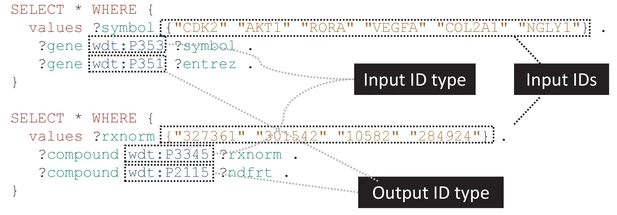
A figure from the article, outlining the idea of using SPARQL queries to extract data from the open knowledge base.
As a reader of my blog, you know I have been doing quite some research where Wikidata has some role.
I am preparing a paper on the work I have done around chemicals in Wikidata, based on what I
presented at the ICCS with a poster.
So, I was delighted when Andra and Andrew asked me to contribute
to a paper outline the importance of Wikidata to the life sciences. The paper was published in eLife,
which I'm excited about to, as they do a significant amount of publishing innovation.
I'll keep this post brief, as I have plenty of work to do, among which is SARS-CoV-2 data in Wikidata. Join this project, after you read the paper: Wikidata as a knowledge graph for the life sciences (doi:10.7554/eLife.52614, or in Scholia):
I'll write up some more queries for this eBook now: Wikidata Queries around the SARS-CoV-2 virus and pandemic.
Additional details
Description
A figure from the article, outlining the idea of using SPARQL queries to extract data from the open knowledge base. As a reader of my blog, you know I have been doing quite some research where Wikidata has some role. I am preparing a paper on the work I have done around chemicals in Wikidata, based on what I presented at the ICCS with a poster.
Identifiers
- GUID
- https://doi.org/10.59350/ee0y3-3ez74
- URL
- https://chem-bla-ics.linkedchemistry.info/2020/03/19/new-paper-wikidata-as-knowledge-graph.html
Dates
- Issued
-
2020-03-19T01:00:00
- Updated
-
2020-03-19T01:00:00
References
- Waagmeester, A., Stupp, G., Burgstaller-Muehlbacher, S., Good, B. M., Griffith, M., Griffith, O. L., Hanspers, K., Hermjakob, H., Hudson, T. S., Hybiske, K., Keating, S. M., Manske, M., Mayers, M., Mietchen, D., Mitraka, E., Pico, A. R., Putman, T., Riutta, A., Queralt-Rosinach, N., … Su, A. I. (2020). Wikidata as a knowledge graph for the life sciences. eLife, 9. https://doi.org/10.7554/elife.52614
- Willighagen, E., Slenter, D., Mietchen, D., Evelo, C., & Nielsen, F. (2018). Wikidata and Scholia as a hub linking chemical knowledge. figshare. https://doi.org/10.6084/m9.figshare.6356027.v1