
Programming in the Life Sciences #5: converting the results into HTML


Now that we have the communication working with the Open PHACTS LDA, it is time to make a nice GUI. I will not go into details, but we can use basic JavaScript to iterate over the JSON results, and, for example, create a HTML table:
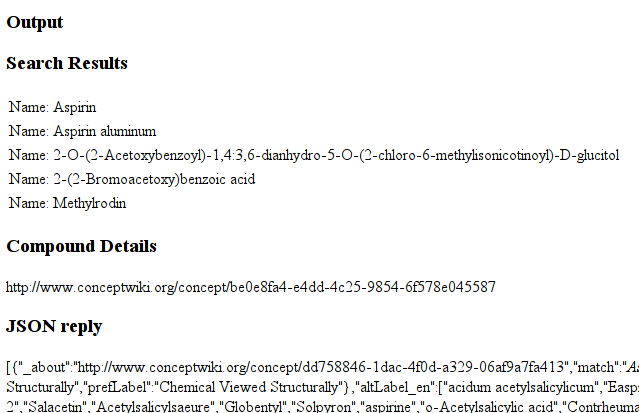
In fact, I hooked in some HTML onClick() functionality so that when you click one of the compound names, you get further
details (under Compound Details), though that only outputs the ConceptWiki URI at this moment. A simple for-loop does
the heavy work:
html = "<table>";
for (var i=0; i<response.length; i++) {
  html += "<tr>";
  html += "<td>";
  dataJSON = JSON.stringify(response[i]);
  //   dataJSON.replace(/"/g, "'");
  html += "Name: <span>" + response[i].prefLabel + "</span>";
  html += "</td>";
  html += "</tr>";
}
html += "</table>";
document.getElementById("table").innerHTML = html;
So, we're set to teach the students all the basics of programming: loops, variables, functions, etc.
Additional details
Description
Now that we have the communication working with the Open PHACTS LDA, it is time to make a nice GUI.
Identifiers
- GUID
- https://doi.org/10.59350/7yj2v-4sz07
- URL
- https://chem-bla-ics.linkedchemistry.info/2013/10/09/programming-in-life-sciences-5.html
Dates
- Issued
-
2013-10-09T02:00:00
- Updated
-
2025-02-15T01:00:00